Notities & Aantekeningen (Notes & Annotations) is still running as an experiment, so I’m only showing what Nedap has already made public, plus how we thought about it. Nedap describes the feature on its support page (in Dutch). Given its relevance to AI, I still want to share as much as I can here.
Something with LLMs
The Nedap Ons® Suite is the market leader in software for non-medical care, such as home care, nursing homes and residential groups.
I started in a new team tasked with exploring what applications LLMs could have within the Ons Suite.
Rather not a chatbot
A chatbot was the obvious choice; at the time it was the answer to almost every AI question. But in our first conversations as a team, it quickly became clear that none of us believed a chatbot would really help care workers. The open format puts a lot of responsibility on the user: you have to learn what to use it for, what not to, and how. With the workload that already exists, we thought it unwise to put these new skills and responsibilities on care workers. Were we convinced that a chatbot would give care workers “more time for care”, Nedap Healthcare’s mission? Or would we keep people chained to their screens even longer, endlessly prompting the chatbot to get the result they wanted?
We asked a new question: how do we use LLMs to speed up a small part of a care worker’s existing process, every day?
Designing for problems you don’t know yet
For sixteen years I started my work by identifying a problem people had. Now the technology was at the centre, a first for me. What made it extra interesting was that we didn’t want to build a point solution; whether you’re a physio in a nursing home, a home care worker or in the invoicing department, you should be able to get value out of our app.
So the job was to design a system that adapts to whatever problems are thrown at it. Agnostic of input.
Where is the intent?
LLMs work best with intent. If an LLM knows a user’s intent, it can take work off their hands or prepare it. But where do you find that intent?
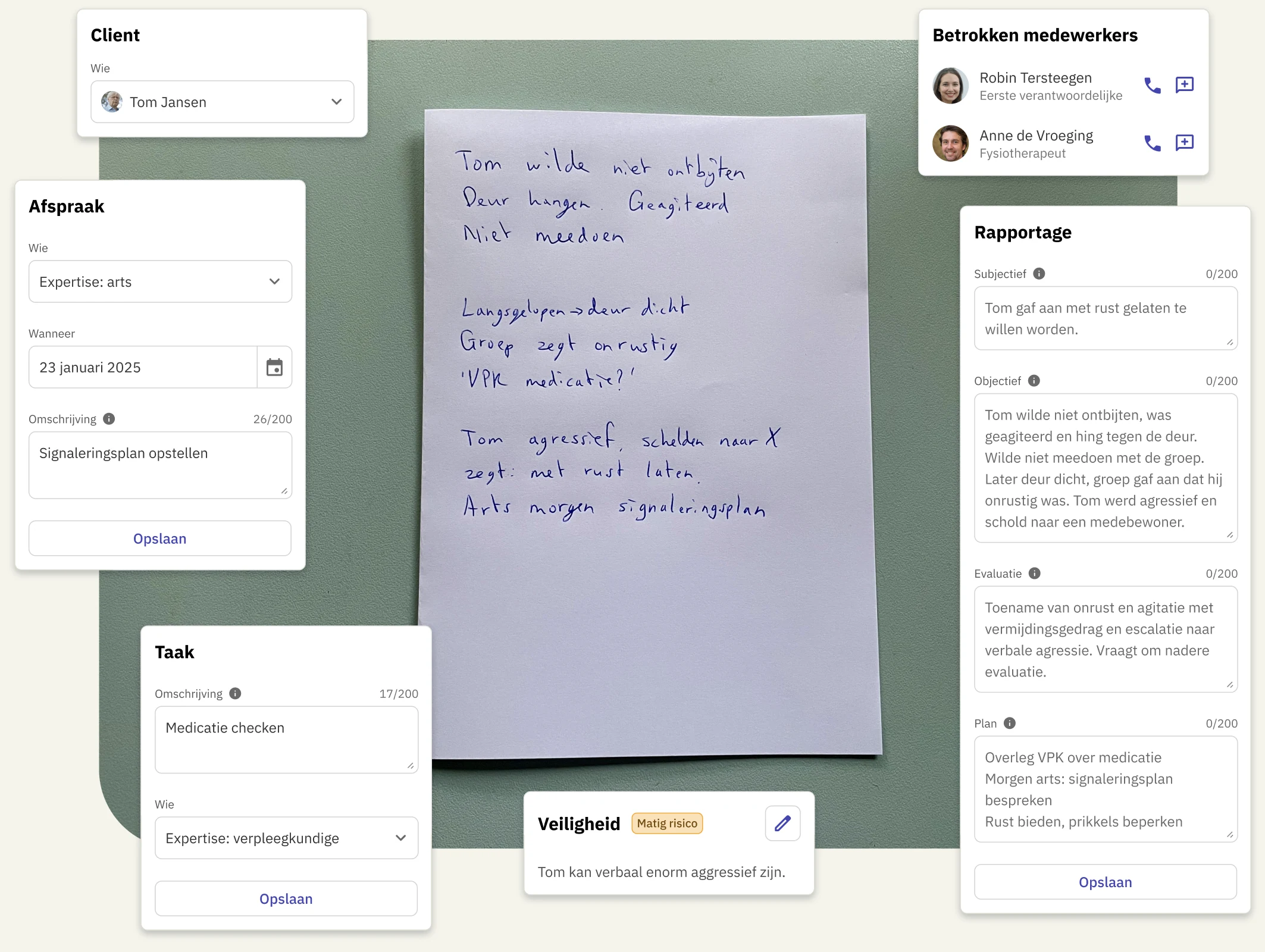
Then I thought of something I’d been hearing about for months: everyone in care makes scribbled notes while they work! That was possibly the first moment people get their intent out of their heads.
Software and user are out of step
We needed to understand more about how care workers record their work: when, how and why? So, as a team, we interviewed care workers from different sectors, to see whether they differ in this. I was responsible for the research design, part of the interviews and all of the analysis.
The research showed that our idea built on something people in every sector already do, for more varied reasons than we’d thought. Most striking was that people said they often first capture their work in a mental model that fits the experience as they lived it. From there, it’s easier for them to translate that experience into the software’s system format. In other words, the software and the user’s experience are out of step. And that’s where we saw an opportunity.
Big ambitions, starting small
At first I dreamed of a whole interface being generated for a person, based on their intent. If someone writes a table on a scribbled note, the interface becomes a table and all you have to do is press “approve”.
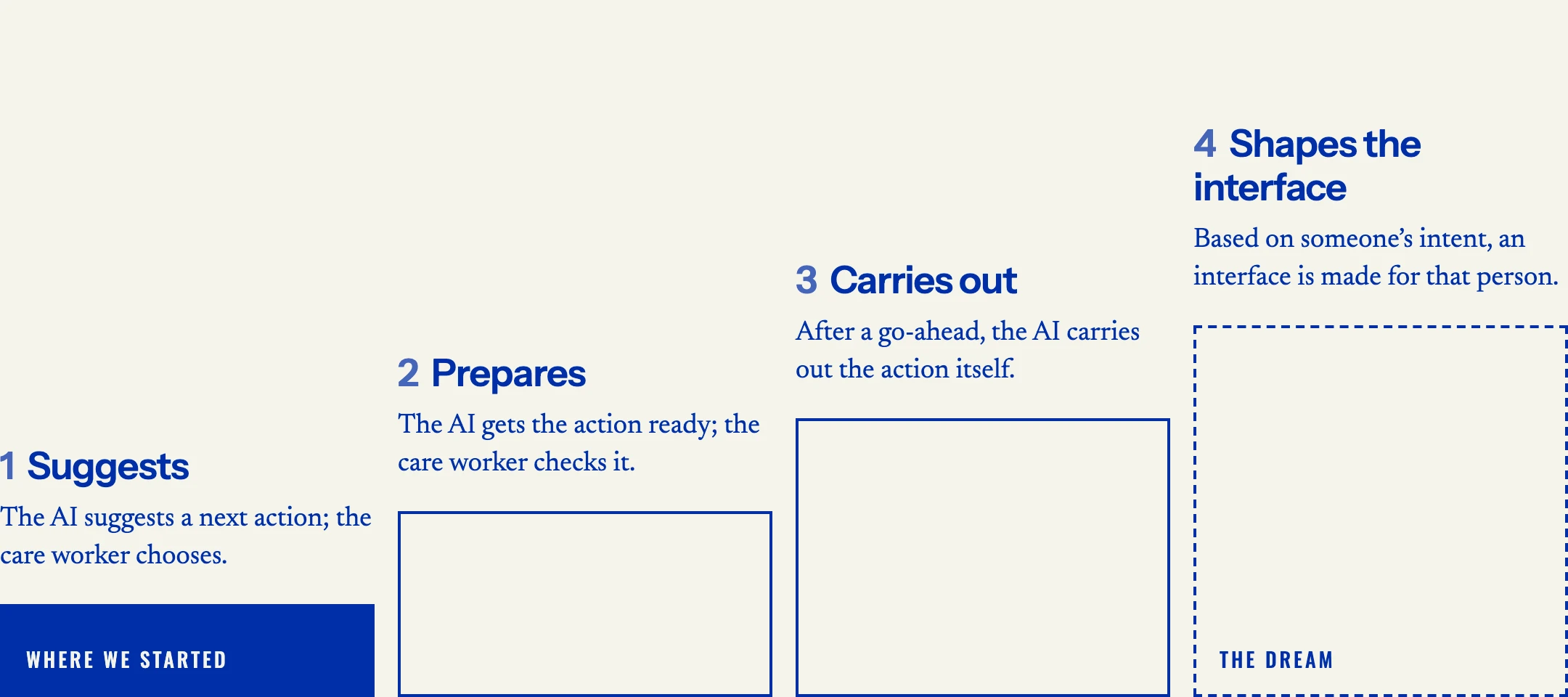
For a first version that was a bridge too far. We brought it back: can an LLM suggest the right next action in the software, based on that intent? If that works, you can grow the AI’s role step by step.
-
1 Suggests
The AI suggests a next action; the care worker chooses.
-
2 Prepares
The AI gets the action ready; the care worker checks it.
-
3 Carries out
After a go-ahead, the AI carries out the action itself.
-
4 Shapes the interface
Based on someone’s intent, an interface is made for that person.
A suggestion, not a decision
It was time to make something. I designed an app in which care workers can capture their note however suits them: typing, dictating, or adding a photo or audio recording. At the press of a button, the AI interprets the note and prepares suggestions for processing it in the Ons Suite. The care worker reviews the suggestions, adds to them where needed and saves them, or rejects them. Nothing goes into a client’s file automatically; the care worker stays in control. That way care workers no longer have to navigate the Ons Suite to record everything one by one; instead, the Suite shapes itself around the care worker.
Where does the project stand?
In care software you can’t take the move fast and break things route; even an experiment has to meet the requirements for production software. Since the third quarter of 2026, Notities & Aantekeningen has been running as an experiment with care organisations.
There are no hard results yet at the time of writing. What is in place is the evaluation plan I drew up based on HEART metrics: how satisfied are care workers with the suggestions, how often do they accept one, and do they keep using the app? That way, how the project continues can be decided on results.
No more “computer says no”
One of the things I discovered during this project is that with AI we can probably build software that shapes itself much more around the user’s experience. People will need to learn “the system” less, there’ll be less “computer says no”, and working with technology will feel more human.